


Most families don’t struggle to build generational stability because they didn’t work hard enough. They struggle because they confuse effort with structure.
Generational stability isn’t about how much money gets passed down. It’s about whether the next generation has to start from scratch, or do they have a solid foundation to stand on after we’re gone.
A lot of us grew up hearing the same message: work hard, take care of your family, thinking things will eventually work out. And for a while, that feels true. Bills get paid. Life moves forward but then you look around and notice something unsettling, every generation is still fighting the same battle, believing they just need to work harder this time.
But the harsh truth is that even after hitting that dream income, generational stability isn’t automatic.
If the plan is to earn more, hope for the best, and trust that the kids will “figure it out,” that’s not stability, that’s a survival mentality.
What Generational Stability Is Not
Before we talk about how families build generational stability, lets talk about the lie. Generation stability is often confused with success. When most people hear generational stability, they picture a finish line. A good job. A bigger house. A retirement account. Maybe something left behind for the kids one day. But we have to be honest about what generational stability looks like.
Stability isn’t the absence of struggling.
Stability isn’t a certain income level. Income can change.
Stability isn’t owning a home. Homes can be lost.
Stability isn’t even having wealth. History shows that wealth fades within 1-2 generations when there’s no structure holding it in place.
What tends to get passed down is not stability, but habits and assumptions.
How we react under pressure. How money is talked about (or avoided). How conflict is handled, and what we do when things don’t go as planned. When those habits aren’t examined, each generation inherits the same problems, just with new circumstances.
Another common assumption is that stability shows up later. Later when work slows down. Later when the kids are older. But families don’t suddenly become structured because life slows down. Life rarely does. Stability is either practiced along the way or not at all.
Understanding what generational stability is not matters, because it clears away the false sense of progress. Once those are out of the way, it becomes easier to talk about what actually lasts, and what families can start building now.
What Generational Stability Actually Looks Like
Generational stability usually doesn’t look like anything special while it’s happening. It’s in our normal conversations and decisions no one outside the family ever sees. That’s part of why it’s so easy to miss.
Basically, families with stability typically operate from a shared way of doing things. It’s not a strict rule book, and it’s not about being perfect either. Everyone may not agree all the time, but everyone understands how choices are made and what matters most, even when circumstances change.
One simple way to think about it is through four anchors that shape how a household runs.
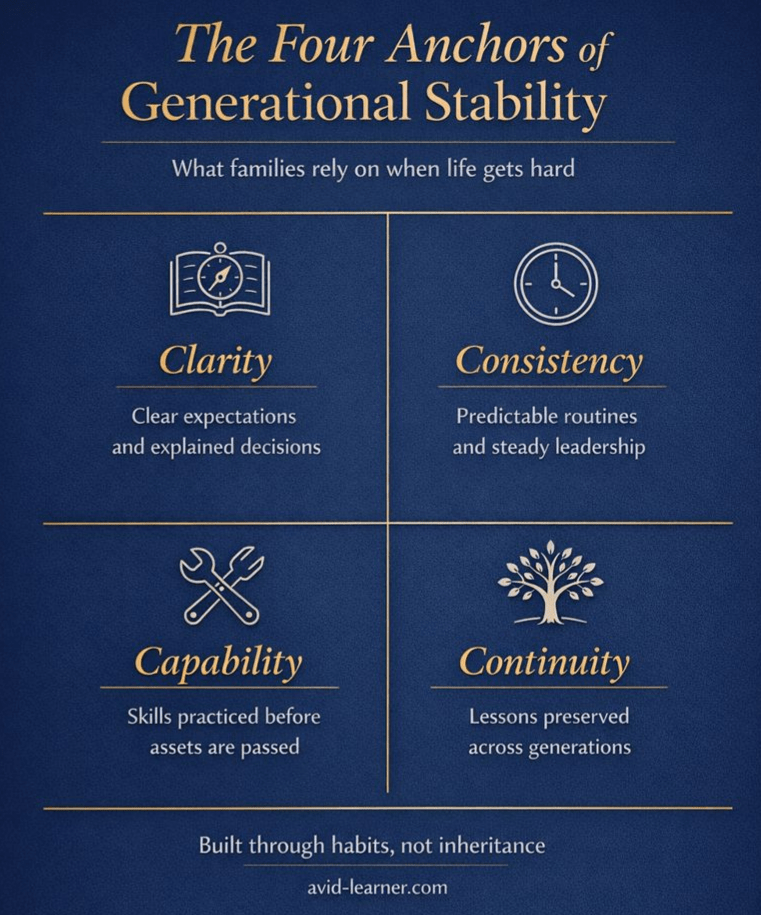
The first anchor is clarity. Stable families talk openly about decisions, priorities, and tradeoffs. They explain decisions instead of keeping everything behind the curtain. Money is discussed rather than avoided. Kids are not left guessing why money is tight, why priorities shift, or why certain choices are off limits. When there is clarity, confusion does not get passed down from one generation to the next.
The second anchor is consistency.Values show up the same way over time. Routines are predictable, and that predictability creates a sense of safety. While consistency may feel boring, it often provides the structure families rely on during uncertain seasons.
The third anchor is capability. Instead of focusing on looking rich, stable families focus on building life skills. Kids are taught how to think through problems, manage emotions, handle money, and recover when they mess up. The goal is not to raise perfect children, but capable adults.
The fourth anchor is continuity. Lessons are passed down intentionally. Experiences are talked about. Mistakes are explained. What one generation learns does not disappear when life circumstances change. Continuity is what keeps families from repeating the same cycles over and over again.
Building generational stability does not require wealth or a perfect family setup. It requires attention. Families that build it tend to return to these anchors again and again, especially when decisions get tough. Over time, those repeated choices form a foundation that lasts.
That is usually how generational stability is built. Quietly. Consistently. Long before anyone realizes how valuable it is.
Start Building Generational Stability at Home Now
Generational stability is not built overnight, and it usually does not start with some big, dramatic move. It starts in the middle of normal life, inside your home, with the people who are watching you most closely.
The families that break cycles and build something lasting do not wait until life feels easier. They start with what they have and adjust as they go.
Discussing family operating codes are key to building generational stability. Here is a checklist of 5 areas you should cover to build a family operating code.
- Decision Making. How decisions are made and who is involved, what factors matter most when deciding, and how mistakes are handled after a decision is made.
- Money Rules. What is money used for in your family. How are spending decisions decided. What debt is acceptable and what debt isn’t. How saving is prioritized and how trade offs are explained.
- Responsibility and Expectations. What responsibility looks like at different ages. What is earned and what is provided. What happens when expectations are not met. Being consistent in this area is important, not how strict your expectations are.
- Conflict and Accountability. How disagreements are handled. What respect looks like in hard conversations. How to apologize and mend relations when they happen. How accountability is handled without shame.
- Value. What gets protected even when life gets busy or chaotic. What are your minimum standards as a family. How to say no to things in order to say yes to the things that matter. What you want to be known for as a family. If values are not implemented and practiced, they will not survive.
Before assets are passed down, skills must also be passed down first. Decision making. Money management. Emotional regulation. Problem solving. Clear communication. These skills shape how the next generation handles responsibility long before they ever touch an inheritance. Without them, even well-intentioned assets can create confusion instead of stability.
This week, pick one family operating code to make visible in your household. Talk through the decision and explain why something is a priority. Write down or explain what that responsibility looks like at each stage of life. Make the process clear enough that someone else could follow it without you in the room.
Generational stability grows when structure feels normal and responsibility is shared over time. Small actions done consistently matter more than big plans that never get used.
Here is the question to sit with and act on. If your family had to keep moving forward without you tomorrow, would the way you live today help them do that with confidence?
Start there.
Do not wait for the perfect moment. Start building generational stability at home now.
 avid-learner.com
Pingback: Why Saving 10% of Your Income Is No Longer Enough—and Might Be Lying to You
Pingback: Why Financial Advice Doesn’t Work for Most People Long-Term